Author: Kateryna Topol
Instagram: @katerryna
Web: pathstotravel.com + quipmag.com

“Is that all you carry with you?” a fellow photographer asked with a hint of astonishment during the recording of a Travel Trends podcast. “Sure is,” he gasped and we all chuckled, reflecting on his robust kit setup for Antarctica expeditions. While I’ve always had a passion for photography, I learned early that I wanted to carry as little equipment as possible.
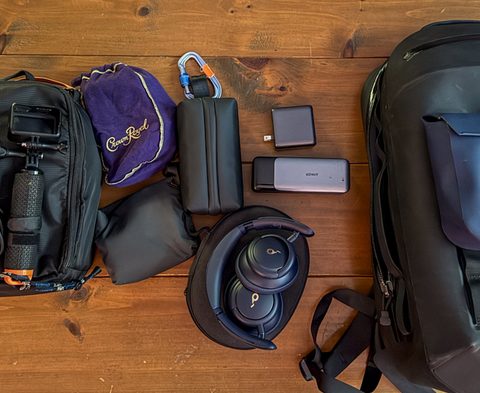
What’s in my bag
All of my training was done with the original Canon Rebel with a kit lens. That camera worked hard, it did its job well even without screen light at dimly lit concert venues. For the upgrade, I wanted a smaller camera with full manual settings and great capacity for low-light photography. Extensive research and social media surveys led me to the mirrorless Fuji X-T100 and a Fuji XF50mm F2 R WR. The 50mm lens is my favourite lens (I love its versatility), and for a long time, it was my only lens. As I began to shoot more hotels, a wide-angle called to me, and so the Fuji XF23mm F1.4 R LM WR lens found its place in the gearbag.
Fuji X-T100 is also a great camera for beginners, and while that model is quite out of day, the follow-up models (X-M5, X-E4, X-T30 II) are worth having a look at. Personally, I was looking for a bit more power and better video, so my most recent upgrade is a Fuji X-H2S, which pairs perfectly with the previously mentioned 50mm and 23mm lenses.
In addition to the core body and 2 lenses, I also occasionally carry a DJI Mavic Mini and always bring extra batteries for both the camera and drone.
Photography foundations to abide by


Your photos are only as good as your mastery of the equipment. So read the manual and practice the photography foundations, aka the exposure triangle:
- Aperture (A or F/stop): The opening through which light passes into the camera. A low number means shallow depth of field and only a portion of your image is in focus (the bit you focus on), while the rest is blurred.
- Shutter speed (SS): The length of time that the sensor inside the camera is exposed to light when taking a photograph. The higher your SS number, the crisper the photo. This also means the higher your SS, the less light it allows in, so for low-light situations, your SS needs to be a low number.
- ISO: Assigns a numerical value to represent the camera’s light sensitivity. Ideally, you don’t go above 1,000 because the higher the ISO, the grainier the image. That being said, low-light situations like concerts and restaurants might demand a higher setting; I try not to go above 1600 for either.
Most photographers I know hardly use fully manual settings and instead choose two of the above as priorities. My go-to is ISO+SS (meaning I set those two values manually) to control the light because I like the high contrast of colours and sharp focus. If you shoot a lot of portraits, aperture (A) might take priority.
My tested and trusted rules


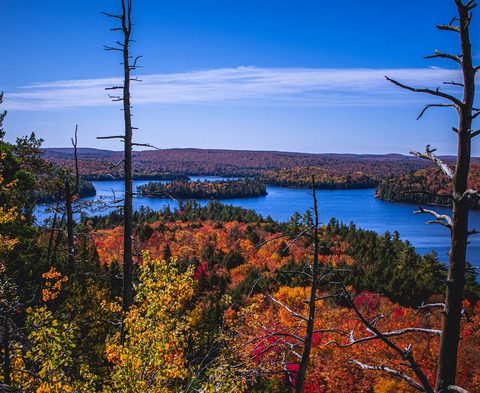
Some people love the editing “room”. I’m not one of them. My goal is to get the photo I need on the spot and only open Photoshop if I need to resize or make minimal adjustments. As such, all photos in this post are unedited.
Knowing your settings well is the first step in getting that shot. Here are some other rules I’ve established for myself over the years:
- Use the rule of thirds to get various angles of the subject matter. Move and rotate your camera, but also move yourself physically (up, down, left, right) to find a different POV
- Always take portrait and horizontal options, just in case.
- Consider positive and negative space to tell the story – all that blue sky framing a building might just be the right thing.
- Remove clutter and unnecessary objects from the frame if you can to avoid having to Photoshop them out.
- Take an image with and without a person in it, a person in the context of nature will illustrate scale, a hand reaching for a cookie will create a story.
- Use existing “frames” to frame your image: architectural archways, windows, mirrors, and tree branches can all work as frames.
- Use natural light to your advantage and avoid shooting with the light behind the subject, it will overexpose and wash out your image.
- Take the photo regardless of the weather and other imperfections, it might still make for an interesting shot.
This story about Hotel Amarano has examples of all of the above, perhaps. I got particularly lucky with the golden hour, which worked out really well for these Hollywood-themed self-portraits.
And last, but perhaps the most important, be done when you’re out of ideas and enjoy the reality beyond the photo.
Explore More
- Find a Henry’s near you
- What’s in My Bag: My Essential Camera & Editing Gear for Content Creation
- What’s in My Bag: Gear Essentials for Capturing the Northern Lights
- What’s In My Bag: An Avid Astrophotographer’s Kit For Capturing The Night Sky
- What’s In My Bag: A Compact Sony Alpha 7CR Kit For Street & Travel Photography
- Camera Bags: Which one is right for you?

Canada’s Greatest Camera Store
Henry’s has long been known in the Canadian photographic industry as the source for the best and newest products, informed Imaging Experts, award-winning customer service and competitive pricing. Henry’s, competitive pricing since 1909 and has evolved into Canada’s largest independent photographic and digital retailer.